String Inverters vs. Microinverters: Which Is Better for Your Solar System?
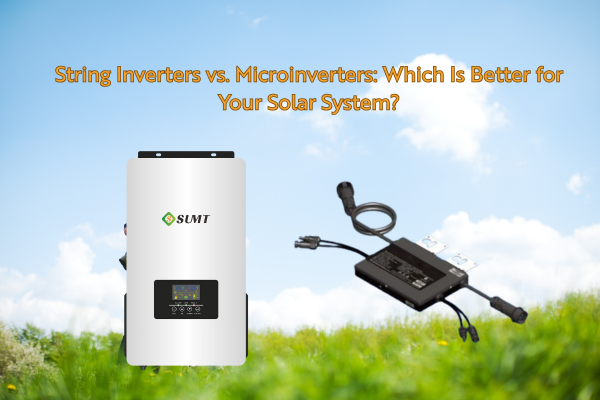
In the construction of a solar power system, the choice of inverter is crucial as it directly affects the system's power generation efficiency and stability. String inverters and microinverters, as the two mainstream types currently, each have their unique advantages and applicable scenarios. The following is a detailed comparison and analysis to help you find the more suitable option for yourself.
Different Applicable Scenarios
String inverters are suitable for larger - scale rooftop or ground - mounted photovoltaic power plants. If your installation site is open, with uniform lighting conditions and few obstructions, then a string inverter is a good choice. It can connect multiple solar panels in series into a string for centralized power conversion, and can well adapt to such a large - area and stable lighting environment.
Microinverters, on the other hand, are more suitable for situations where there are obstructions on the roof, the solar panels face different directions, or the installation area is small. For example, if your roof has obstructions such as chimneys and trees, or the solar panels need to be installed on slopes with different orientations, microinverters can perform power conversion for each solar panel individually, effectively reducing the impact of obstructions and ensuring that each solar panel can achieve good power generation performance.
Differences in Power Generation Efficiency
Under ideal lighting conditions without obstructions, string inverters have excellent power generation efficiency. Because they adopt a centralized conversion method, energy loss is relatively small, and they can efficiently convert solar energy into electricity.
However, when there is an obstruction problem, the advantage of microinverters becomes prominent. In a string inverter system, once one of the solar panels is shaded, it will affect the power generation efficiency of the entire string; while microinverters control each solar panel individually, and shading on one solar panel will not affect the normal operation of other solar panels, so the overall power generation efficiency is more guaranteed.
Differences in Installation and Maintenance
The installation of string inverters is relatively centralized. It only needs to install one or several units in a suitable position, the installation process is relatively simple, and the construction period is short. However, its maintenance requires professional personnel to go to the centralized installation location. Once a fault occurs, it may affect the operation of the entire string, and the maintenance cost and difficulty are relatively high.
Microinverters are installed on the back of each solar panel, and the installation process needs to be carried out one by one, which is relatively cumbersome. But in terms of maintenance, it has obvious advantages. If a microinverter fails, only that one needs to be replaced or repaired, which will not affect the power generation of other solar panels. The maintenance cost is low, and troubleshooting is also simpler.
Cost Considerations
In terms of initial investment, the cost of string inverters is relatively low. Because a single unit has a large power, when installing on a large scale, the number of inverters needed is small, and the overall procurement cost will be lower.
Microinverters require one for each solar panel, so the initial investment cost is higher. But in the long run, if your solar power system has problems such as obstructions, microinverters can reduce power generation losses, and the long - term economic benefits may be better. Moreover, their low maintenance cost can also reduce long - term expenses to a certain extent.
In conclusion, when choosing between string inverters and microinverters, you should comprehensively consider your installation site conditions, power generation needs, and cost budget. If your installation site has uniform lighting without obstructions, and you pursue low initial cost and large - area centralized installation, string inverters are a suitable choice; if your site has obstructions, the solar panels face complex directions, and you pay attention to long - term power generation efficiency and low maintenance cost, then microinverters can better meet your needs.
How to improve the efficiency and power generation of inverter?
How to Connect Inverters to Generators?
Related Article