How MPPT Controllers Intelligently Manage Battery Charging
1. Why MPPT Is More Than Just a “Power Tracker”
In solar systems, MPPT (Maximum Power Point Tracking) controllers are widely known for improving photovoltaic module efficiency. However, their equally critical role is often overlooked: intelligently managing battery charging.
An MPPT controller doesn’t simply push energy into the battery—it acts like a smart charging manager, constantly sensing battery conditions and adjusting charging parameters for safety, efficiency, and longevity.
2. The 3-Stage Smart Charging Strategy of MPPT Controllers
High-performance MPPT controllers typically implement a 3-stage charging algorithm suitable for both lead-acid and lithium batteries:
1. Bulk Stage (Constant Current Charging)
When battery voltage is low, the controller delivers maximum allowable current to quickly recharge about 80% of capacity.
Goal: Rapid power-up.
2. Absorption Stage (Constant Voltage)
Once voltage reaches the absorption threshold (e.g., 28.8V for 24V systems), the controller maintains a steady voltage while the current gradually drops, safely filling the remaining 20%.
Function: Prevents overheating and overcharging.
3. Float Stage (Maintenance Charging)
When the battery is full, the controller switches to a lower float voltage (e.g., 27.2V for 24V systems) to maintain battery health and prevent self-discharge.
Benefit: Keeps battery healthy in standby.
✅ Some advanced controllers also support equalization charging for flooded lead-acid batteries to rebalance cell voltage periodically.
3. Intelligent Battery Type Recognition & Dynamic Adjustment
Modern MPPT controllers are equipped with MCU chips and intelligent battery identification algorithms that allow automatic or manual configuration for various battery types, including:
-
LiFePO₄ (Lithium Iron Phosphate)
-
GEL (Gel-type lead-acid)
-
AGM (Absorbed Glass Mat)
-
Flooded (Open lead-acid)
-
Custom (User-defined profiles)
The controller dynamically adjusts charging curves based on battery type, including:
-
Absorption voltage
-
Float voltage
-
Max charging current
-
Temperature compensation
Let’s take a closer look:
✅ LiFePO₄ (Lithium Iron Phosphate)
Requires high precision. Absorption voltage for a 12V system typically ranges from 14.2V to 14.6V. Float voltage may be lowered or skipped to extend battery life. Max charge current is recommended below 0.5C (e.g., 50A for a 100Ah battery). Must include low-temperature charge protection (do not charge below 0°C).
✅ GEL Battery
Uses silica-based electrolyte, with low self-discharge. Absorption voltage: 14.0V–14.2V; Float: 13.5V–13.8V. Recommended charge current: ≤0.25C. Sensitive to overcharging—best suited for deep cycle applications.
✅ AGM Battery
Low internal resistance, suitable for high-power loads. Absorption voltage: 14.4V–14.7V; Float: 13.5V–13.8V. Can accept 0.3C–0.4C charging current. Performs well in wide temperature ranges.
✅ Flooded Battery
Traditional, low-cost, but requires regular maintenance. Absorption voltage: 14.6V–14.8V; Float: 13.4V–13.7V. Charging current: 0.2C–0.3C. Emits gases—avoid use in sealed environments.
✅ Custom Battery Type
For specialized lithium packs or BMS-integrated batteries. Users can define voltage/current/temperature limits. Advanced MPPT controllers may support RS485 or CAN communication with BMS brands like PylonTech, WECO, BULLS POWER, etc.
Example: When ambient temperature drops below 0°C, the controller automatically reduces or disables LiFePO₄ charging. When using GEL batteries, charge current is limited to prevent overheating and sulfation.
This adaptive coordination of battery type, system status, and ambient temperature is what enables MPPT controllers to act as a “Battery Guardian” in solar applications.
4. Current Control & Overcurrent Protection: The Soft Power of MPPT
Beyond smart algorithms, current regulation plays a vital role in safe charging. MPPT controllers constantly monitor voltage, current, and battery temperature, dynamically adjusting output based on:
-
Battery capacity
-
Charging stage
-
Thermal conditions
This prevents:
-
Overheating
-
Battery swelling
-
System overload
High-end models even support temperature-compensated charging curves, further extending battery lifespan.
5. Conclusion: Why a Good Inverter with Built-in MPPT Is the Smarter Choice
The value of an MPPT controller lies not only in maximizing solar panel efficiency—it also plays a dual role as a “smart charging manager” and “battery protection expert.”
For off-grid or hybrid energy storage systems, choosing an inverter with a built-in MPPT controller is a smart, practical decision that balances performance, installation simplicity, and cost efficiency.
Compared to separate “controller + inverter” systems, all-in-one MPPT inverter solutions offer major advantages in:
-
Wiring simplification
-
Space-saving
-
Easier commissioning
-
System compatibility
This makes them ideal for homeowners, microgrid integrators, EPC engineers, and export traders.
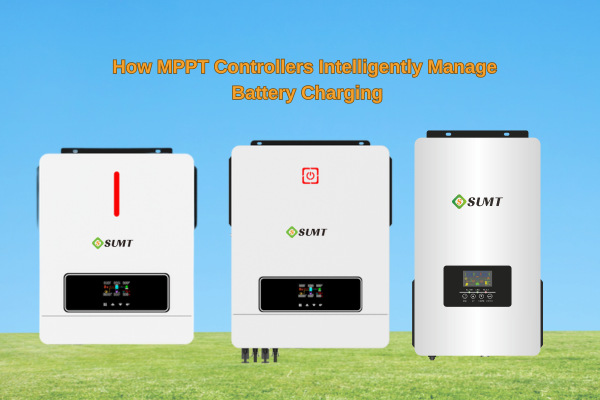
At Shenzhen Sanruite Technology Co., Ltd. (SUMT), we specialize in delivering high-performance, cost-effective integrated MPPT inverter solutions to the global market:
-
Over 10 years of industry experience in R&D and manufacturing
-
Factory area of 60,000+ sqm, monthly output of 200,000 units
-
Product lines cover off-grid, hybrid, and parallel-enabled inverter models
-
Built-in MPPT charge controllers (80A/100A/120A/160A) for high efficiency and stable output
? Recommended Models:
-
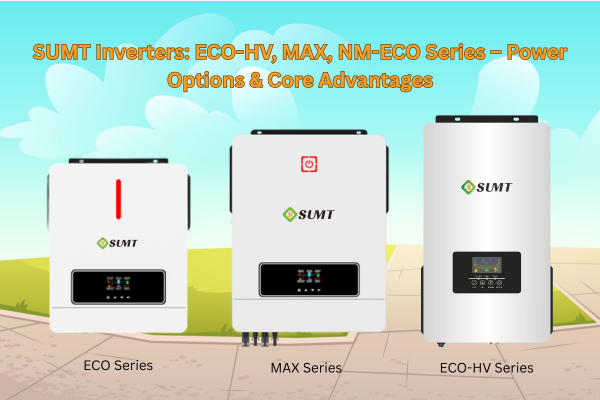
ECO Series (4.2KW / 6.2KW): Off-grid + grid-tie hybrid inverter, supports Wi-Fi remote monitoring, ideal for homes and small businesses
-
MAX Series (8.2KW / 10.2KW): Powerful hybrid inverter with 160A MPPT, dual AC output, and BMS communication for lithium batteries
-
ECO-HV Series (3KW–6.5KW): Supports parallel, split-phase, and 3-phase output, ideal for larger residential or commercial systems
Our solutions are widely used in homes, shops, rural areas, integrated projects, wholesale and cross-border e-commerce scenarios.
Whether you are a system integrator, importer/distributor, or e-commerce retailer, choosing a SUMT integrated MPPT inverter will streamline installation, reduce costs, and create a fast, high-efficiency path from delivery to value.
? Contact us today to get technical datasheets, system sizing support, or OEM/ODM customization. With ISO9001 and BSCI certifications and products compliant with CE, IEC, TUV, and VDE standards, SUMT is your trusted global solar partner.
When Energy Storage Moves Beyond Backup Power: How Should We Rethink Hybrid Inverters in 2026?
Can solar inverters continue to work during a power outage?
Related Article